Notes from the atelier
Crocodile, python, ostrich: learning to read an exotic hide
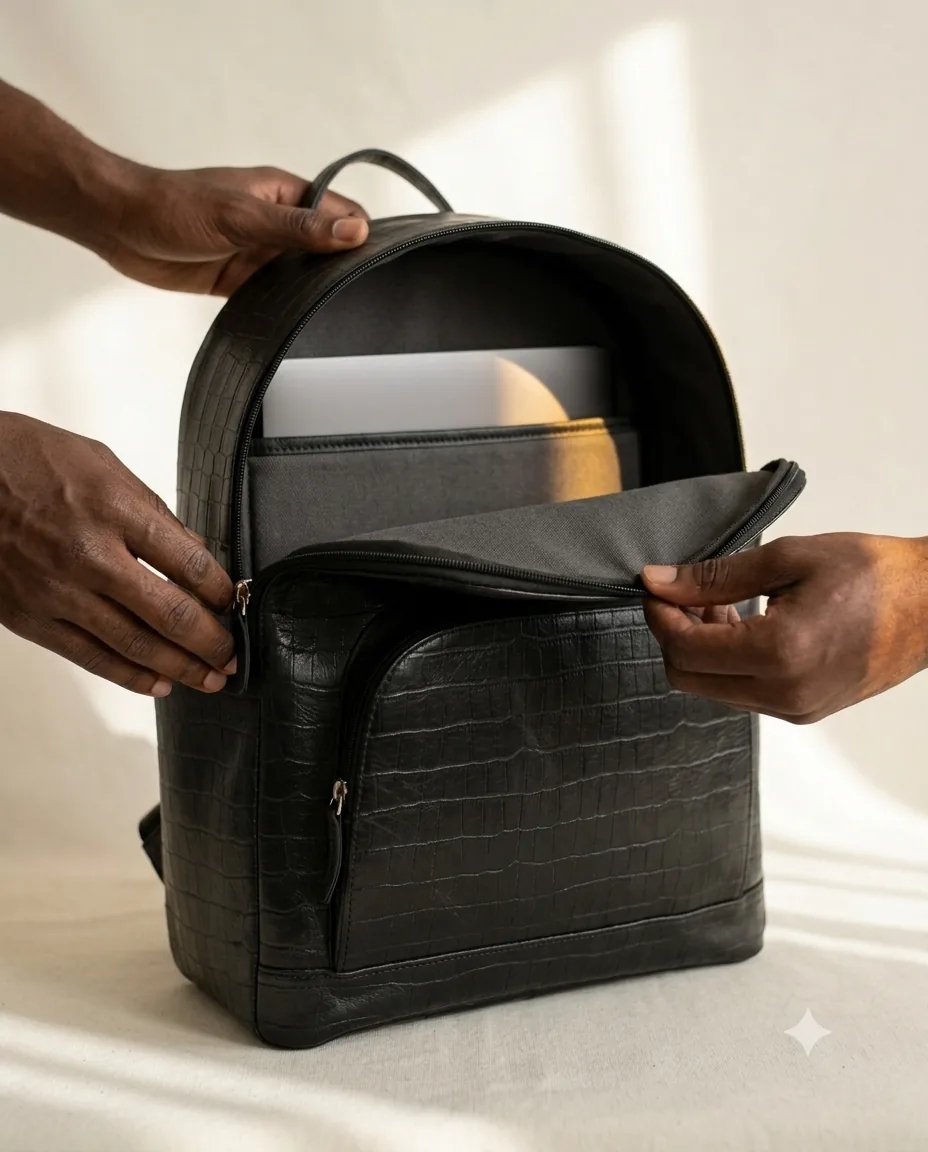
An exotic skin is not chosen from a photograph. It is read. Each species has a script — the size and regularity of its scales, the suppleness of its flesh, the way it takes light — and that script says everything: where the skin comes from, how it was tanned, and what can be made of it.
Crocodile: symmetry
On a crocodile, look at the centre. The belly carries wide, regular, almost rectangular scales that tighten towards the flanks. That central, symmetrical zone is what gives the skin its value: the wider and more regular it is, the larger the piece that can be cut from it in one go — a flap, the face of a bag — with no join. A skin with a narrow centre will only yield small pieces, however beautiful.
Touch reveals the tanning. A good crocodile is supple, almost warm, and the scales move against each other without cracking. If it is stiff, or if the shine seems to sit on top, the skin has often been heavily finished, sometimes to hide flaws.
Python: the pattern
Python is recognised by its fine scales, overlapping like tiles, and by its pattern — dark markings edged with light, never twice the same. It is a light, long skin, suited to handles, shoulder straps and the bands of a bag. It asks for careful lining: the scales lift over time if nothing holds them, and it is precisely that living relief, when mastered, that gives it its charm.
Ostrich: the follicles
Ostrich carries no scales but follicles — the raised points left by the feathers. Their density is not uniform: the tightest zone, at the centre of the back, is the most sought after, and a skin is judged by the size of that zone. It is the most supple of the exotic leathers, and one of the strongest: it takes on a patina without scarring.
What the atelier does differently
- The pattern is laid on the skin, not the other way round. Pieces go where the skin is beautiful, and the model adapts to what the skin gives.
- The skiving is finer. Scales do not forgive a thick edge: the stitch must pass without breaking them.
- Every skin is unique. Two crocodile bags will never be identical, and that is what you are buying.
You do not order a crocodile piece. You bring it out of a skin.
This is why, at Koko, exotic-skin pieces are handled as bespoke. We show you the skin before we cut it. You choose the zone. And the bag that comes out of it exists only once.